
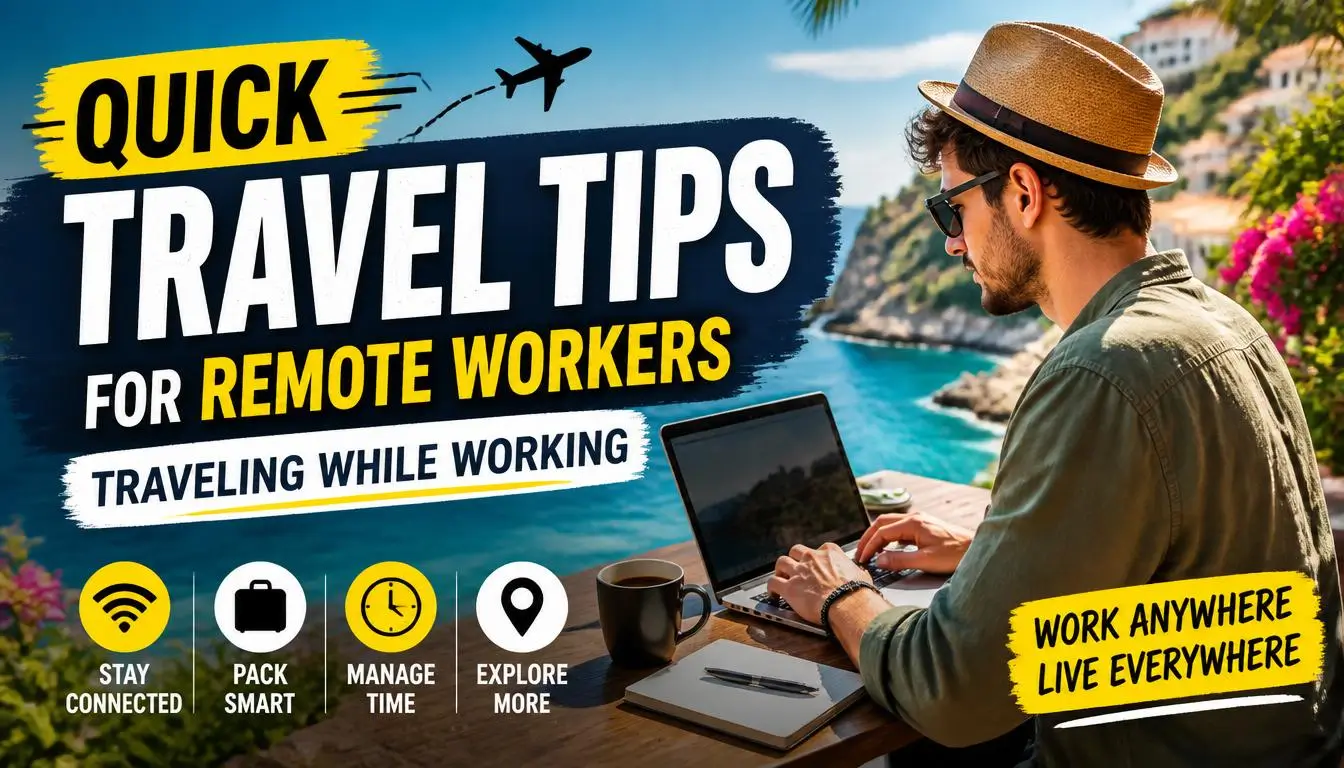
Quick Travel Tips for Remote Workers Traveling While Working
The quick travel tips for remote workers traveling while working that actually matter aren’t about finding Instagram-worthy cafés or perfectly curated Airbnbs. They’re about not getting fired because the wifi cut out during a client call, not burning out from working 12-hour days in “paradise,” and not resenting travel because you’re chained to your laptop the entire time. I’ve worked remotely from 23 countries over four years, and these are the unglamorous strategies that kept me employed, productive, and mostly sane.
Test Your Setup One Week Before You Leave
The biggest mistakes happen at home, not on the road.
I once arrived in Lisbon and realized my laptop charger didn’t work with my international adapter. I’d tested the adapter with my phone charger, assumed it would work for everything, and was wrong. I spent my first day frantically searching for an electronics store instead of working.
One week before departure, I now run a complete systems check:
- Charge all devices fully, then drain and recharge using the adapters and converters I’m bringing
- Test my backup portable charger to ensure it actually holds a charge
- Confirm my VPN works and I remember the login
- Check that all necessary software is updated and licenses are current
- Download offline versions of any documents or files I might need
- Make sure my headphones work and I have backups
- Test video call quality on my phone as backup if laptop fails
This takes 30 minutes and has saved me from disaster multiple times.
I also screenshot important confirmation numbers, wifi passwords from previous stays, and emergency contact info for my IT department. I store these in a folder on my phone that’s accessible offline.
Remote work depends entirely on technology. Testing before you leave is the difference between smooth productivity and crisis management from a foreign country.

Only Work from Destinations with Coworking Spaces
I used to think I could work from anywhere: beaches, cafés, parks, my Airbnb couch.
Reality: beaches have glare and sand in your keyboard. Cafés have terrible wifi and you feel guilty after three hours. Parks have no power outlets. Airbnb couches destroy your back after two days.
I only travel to cities with established coworking spaces now.
Coworking spaces provide:
- Reliable, fast wifi (usually 50+ Mbps, often with backup connections)
- Ergonomic chairs and real desks
- Power outlets everywhere
- Meeting rooms for private calls
- Other remote workers who understand when you need silence
- Coffee and sometimes snacks
I use Coworker.com to search coworking spaces before booking travel. If a city doesn’t have at least two options, I don’t go there for a working trip.
Day passes typically cost $10 to $25. Monthly memberships run $100 to $300 depending on location. This sounds expensive until you calculate the cost of:
- Buying coffee at cafés to justify sitting there ($5 to $8 daily)
- Wasted time with bad wifi causing delays and missed deadlines
- Chiropractor visits because you worked from a bed for two weeks
- Lost productivity from distractions and discomfort
Coworking spaces aren’t luxuries. They’re infrastructure that makes remote work while traveling actually viable.
Book Accommodation for Half the Trip Length Upfront
Never book your entire trip accommodation in advance when working remotely.
You don’t know if the wifi actually works until you’re there. You don’t know if the neighborhood is too loud for calls. You don’t know if the desk situation is usable or the lighting is terrible.
I book the first week or two, then extend or find a new place based on how it’s actually working.
Airbnb and Booking.com both allow you to message hosts and ask specific questions before booking:
“What’s the download/upload speed of the wifi?”
“Is there a dedicated workspace with a desk and chair?”
“How quiet is the apartment during typical working hours (9 a.m. to 5 p.m.)?”
“Are there any planned construction or renovations nearby?”
Hosts who answer specifically and quickly are usually reliable. Hosts who give vague answers (“wifi is fine”) are red flags.
I also look for “long-term stay” discounts. Many hosts offer 20 to 30% off for stays longer than a month. After the first week proves the setup works, I negotiate an extended stay at the discounted rate.
This approach prevents getting locked into a month-long lease in a place where you can’t actually work, while still allowing flexibility to settle somewhere good.
Work Your Home Time Zone for the First Week
Jet lag destroys productivity more than bad wifi.
When I first started traveling while working, I’d land in a new time zone and immediately try to adjust. I’d force myself awake at 7 a.m. local time to “get on schedule,” then be useless by 2 p.m., miss meetings because I miscalculated time zones, and generally perform terribly for a week.
Now I keep my home time zone for the first five to seven days, then gradually shift.
If I’m based in New York (EST) and travel to Lisbon (five hours ahead), I keep working 9 a.m. to 5 p.m. EST. That’s 2 p.m. to 10 p.m. Lisbon time.
It sounds weird, but it works:
- No jet lag affecting my work performance
- No missed meetings because I’m sharp during my normal hours
- My mornings are free to explore, adjust, and settle in
- I shift gradually by going to bed 30 minutes earlier each night until I’m on local time
By week two, I’m working local hours and fully adjusted.
This only works if your job allows some flexibility. If you have rigid meeting schedules, you may not have this option. But if your work is mostly async or you can control your calendar, keeping home time zone initially is a productivity game-changer.
Have Three Backup Internet Plans
Your primary wifi will fail. Not maybe. It will.
Always have backups:
Backup 1: Mobile hotspot
I have an international phone plan through Google Fi ($70/month for unlimited international data in 200+ countries). When accommodation wifi fails, I hotspot from my phone.
T-Mobile and some other carriers offer international data too, though often slower. Check your plan before leaving.
Backup 2: Local SIM card
I buy a local SIM card within 48 hours of arriving anywhere I’m staying more than a week. This gives me local data separate from my U.S. plan and often faster speeds.
Local SIM cards in most countries cost $10 to $30 for 20 to 50GB, plenty for backup hotspot use.
Backup 3: Coworking space or café with known good wifi
I identify a coworking space and two cafés with reliable wifi within the first two days. If both my accommodation wifi and mobile hotspot fail (rare but has happened), I know exactly where to go.
I keep addresses, hours, and walking directions saved offline on my phone.
Triple redundancy sounds paranoid until you’re on a deadline and everything fails simultaneously. Then it’s the only thing preventing panic.
Set Hard Work Hours and Actually Stop
The biggest trap of working while traveling is never stopping.
You’re in a beautiful place. You feel guilty not exploring. So you work from 7 a.m. to noon, explore in the afternoon, then work again from 7 p.m. to 11 p.m. to “catch up.”
You’re working 12-hour days while traveling and calling it work-life balance. It’s not. It’s just work in a nicer location.
I set strict hours now: 9 a.m. to 5 p.m. or 10 a.m. to 6 p.m., depending on timezone. When the workday ends, I close my laptop and don’t reopen it until the next morning.
This requires:
- Communicating boundaries clearly with coworkers and clients
- Turning off Slack notifications outside work hours
- Physically leaving my accommodation after work so I’m not tempted to “just check one thing”
- Accepting that some days I won’t finish everything, and that’s fine
The whole point of working remotely while traveling is experiencing new places. If you’re working 60 hours a week, you’re not traveling. You’re just living in a different apartment and never leaving it.
Eight focused hours of work beats 12 distracted hours every time. Protect your off-hours as aggressively as you protect meeting time.
Choose Destinations with Overlap Time Zones When Possible
Time zones are the hidden difficulty of remote work while traveling.
If your team or clients are in New York and you’re in Tokyo, you have a 13-hour difference. Your 9 a.m. is their 8 p.m. the previous day. Real-time collaboration is nearly impossible.
When possible, I choose destinations with manageable time zone overlap.
Working from U.S. East Coast, my easiest destinations are:
- Europe (5 to 8 hours ahead): I can work afternoons/evenings local time and overlap with U.S. mornings
- South America (0 to 3 hours difference): Almost complete overlap
- Mexico/Central America (same or 1 to 2 hours difference): Perfect overlap
My hardest destinations:
- Southeast Asia (11 to 13 hours ahead): Almost no overlap
- Australia/New Zealand (14 to 17 hours ahead): Completely inverted schedules
I still travel to difficult time zones, but I’m strategic about when. If I have a light work month with few meetings, Asia works. If I have a heavy collaboration period, I stay in the Americas or Europe.
Understanding this before booking prevents accepting a job that requires daily 2 a.m. video calls.
Pack Like You’re Working, Not Vacationing
Remote workers pack differently than tourists.
Tourists bring cute outfits and minimal tech. Remote workers bring work gear and minimal clothing.
My packing essentials:
Tech:
- Laptop and charger (obviously)
- International adapter with multiple USB ports
- Backup portable charger (20,000mAh minimum)
- Phone and charger
- Wired earbuds as backup to wireless headphones
- External mouse (laptop trackpads destroy your wrist after weeks of use)
- HDMI cable if I think I’ll present or want dual monitors
- Portable laptop stand (improves ergonomics massively, folds flat)
Clothing:
- One week of clothes maximum, regardless of trip length
- Everything should work for both work video calls and exploring
- Solid colors layer better and look more professional on video
- One “client call” outfit that looks polished on camera
I do laundry weekly. I don’t pack “just in case” items. Space and weight go to work gear, not clothes.
The laptop stand sounds extra but it’s not. Working hunched over a laptop on a desk for weeks causes neck and shoulder pain that ruins trips. A $25 foldable stand prevents that.
Use Time Tracking to Prevent Work Creep
When your office is wherever your laptop is, work expands infinitely if you let it.
I use Toggl Track (free version) to log every work minute. I start the timer when I open my laptop for work. I stop it for lunch, breaks, and when I’m done for the day.
At the end of each week, I review:
- Did I work my target hours (usually 40)?
- Am I working way over without realizing it?
- Are certain tasks taking longer than they should because I’m distracted?
This creates visibility. Without tracking, I’d assume I worked eight hours when I actually worked five distracted hours, then feel guilty and work more in the evening.
Or I’d work 55 hours without noticing, burn out, and resent the whole “work while traveling” thing.
Tracking shows reality. Then I adjust. If I’m consistently under hours, I tighten focus during work time. If I’m over, I set better boundaries.
The free version of Toggl is plenty. You don’t need fancy features. Just start/stop functionality and weekly reports.
Book Flights That Don’t Wreck Your Work Week
I used to book the cheapest flight regardless of timing. Red-eyes. Connections with short layovers. Arrivals at midnight.
Then I’d be useless for two days recovering, miss deadlines, and stress about work piling up.
I book flights strategically now:
- Leave Friday evening or Saturday so I have the weekend to recover and settle
- Arrive Saturday or Sunday so Monday I’m rested and ready to work
- Avoid red-eyes unless I can take the next day fully off
- Pay slightly more for direct flights to avoid the exhaustion of connections
A $50 cheaper flight that wrecks your productivity for two days costs more in lost work and stress than just paying for the better timing.
I also block my calendar the day I arrive somewhere new. No meetings, no tight deadlines. Just admin work, emails, and settling in.
Travel days are not work days. Treating them as such prevents burnout and maintains consistent work quality.
Communicate Transparently with Your Team
Your team doesn’t need to know every detail of your travel, but they need to know enough to work with you effectively.
I send a brief message before any trip:
“Heads up, I’ll be working from [city] from [dates]. My work hours will be [time] to [time] [timezone]. I’ll have reliable internet and full availability during those hours. If you need me outside that window, text me and I’ll do my best to accommodate.”
This prevents:
- People assuming you’re on vacation and unavailable
- Surprise meeting invites at 3 a.m. your time because they forgot you’re abroad
- Resentment from coworkers who think you’re slacking off
I also update my Slack status with my current timezone and working hours. Small thing, huge impact.
Transparency builds trust. Surprises erode it.
If you’re working remotely while traveling without your employer’s explicit permission, obviously this doesn’t apply. But if your company allows it, overcommunicate rather than under.
Frequently Asked Questions
What are the best quick travel tips for remote workers traveling while working on a tight budget?
Choose cheaper destinations (Southeast Asia, Eastern Europe, Latin America), use coworking day passes instead of monthly memberships, cook most meals, stay in affordable neighborhoods outside tourist centers, use local SIM cards instead of expensive international plans, and book accommodation with long-term discounts. Prioritize reliable wifi and workspace over location aesthetics.
How do I stay productive while working remotely from a different country?
Maintain consistent work hours, use coworking spaces for focus, have backup internet plans, minimize distractions by treating work time like office time, use time tracking to stay accountable, communicate clearly with your team about availability, and protect your sleep schedule. Productivity comes from routine and boundaries, not location.
Can I work remotely while traveling if my job requires lots of video calls?
Yes, but choose destinations carefully. You need excellent wifi (test before committing to accommodation), quiet spaces for calls (coworking phone booths or private rooms), reasonable time zone overlap with your team, and backup plans when tech fails. Book accommodations with dedicated workspaces, not just couches. It’s doable but requires more planning than async work.
What destinations are easiest for remote workers traveling while working for the first time?
Mexico City, Lisbon, Chiang Mai, Medellín, and Barcelona all have excellent coworking infrastructure, affordable cost of living, reliable internet, large digital nomad communities, and manageable time zones for U.S. or European workers. These cities have solved for remote workers, so the infrastructure already exists. Start with established digital nomad hubs before trying less common destinations.
How do I avoid burnout when working remotely while traveling?
Set hard work hour boundaries and stick to them, take full days off weekly, don’t work from your bed or couch, actually explore your destination outside work hours, maintain exercise and sleep routines, and be honest when you need a break. Slow down your travel pace. Moving cities weekly while working full-time is a recipe for exhaustion. Stay places for weeks or months, not days.
Conclusion
Working remotely while traveling isn’t an extended vacation. It’s your regular job in different locations, with added logistics and potential complications. The people who do it successfully long-term aren’t the ones with the best Instagram feeds. They’re the ones with the most boring, reliable systems. Build your infrastructure, set your boundaries, and remember that the goal is sustainable productivity, not proving anything to anyone. What’s your biggest concern about working while traveling?