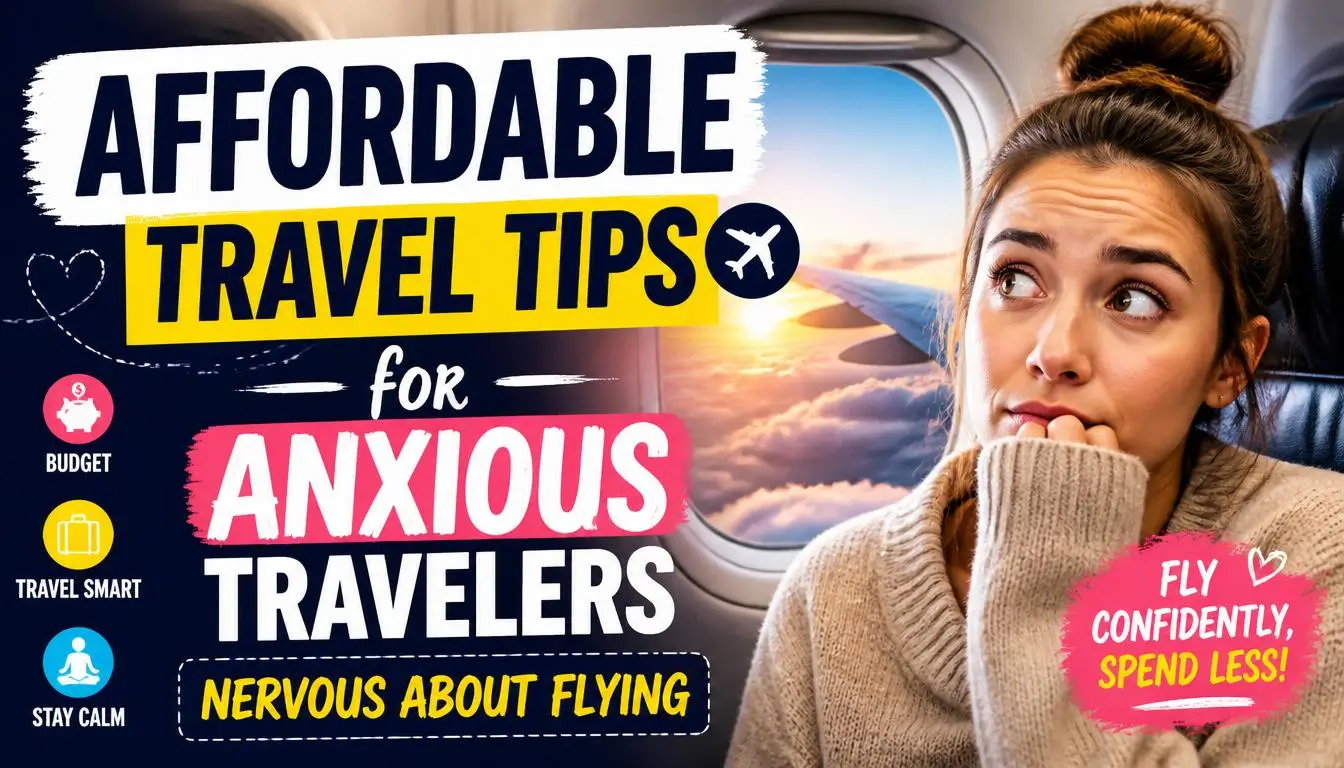
Affordable Travel Tips for Anxious Travelers Nervous About Flying
Finding affordable travel tips for anxious travelers nervous about flying shouldn’t mean choosing between your mental health and your budget. I’ve had full panic attacks at 35,000 feet, white-knuckled through takeoffs while convinced we were about to crash, and spent hundreds of dollars on last-minute seat upgrades and airport drinks trying to calm down. These strategies finally got me flying regularly without either losing my mind or emptying my bank account on anxiety band-aids that barely worked.
Book Morning Flights Even Though They’re Inconvenient
Morning flights are statistically smoother because the air is calmer before the sun heats the ground unevenly and creates turbulence.
They’re also cheaper to book in many cases, especially the truly early ones. A 6 a.m. departure often costs $30 to $60 less than an 11 a.m. or 2 p.m. flight on the same route.
The biggest advantage for anxious flyers isn’t the price or the smooth air. It’s the lack of anticipation time.
If your flight leaves at 6 a.m., you’re waking up at 3:30 or 4 a.m., getting ready in a fog, and arriving at the airport still half-asleep. You don’t have eight hours to spiral about everything that could go wrong.

Afternoon and evening flights give you all day to Google plane crash statistics, refresh the weather forecast obsessively, and convince yourself this is the flight where something terrible happens.
Early flights hurt short-term because you’re exhausted. But they prevent the all-day anxiety buildup that makes the actual flight exponentially worse.
I book flights before 9 a.m. whenever possible now. I’m grumpy and tired, but I’m not a wreck before I even board.
Use Free Anxiety Apps Instead of Expensive Therapy Programs
Flight anxiety therapy programs exist. SOAR costs around $300. Fearless Flight courses run $200 to $400. Some work well, but that’s a lot of money if you’re already on a tight budget.
Free and cheap alternatives help almost as much.
Insight Timer has free guided meditations specifically for flight anxiety. I use the “Fear of Flying Meditation” by Boho Beautiful before every flight. It’s 15 minutes, completely free, and genuinely calms my nervous system.
Dare app teaches a response method for panic attacks. The approach is simple: when anxiety spikes, you acknowledge it, accept it, and redirect. “I’m feeling anxious. That’s okay. Anxiety can’t hurt me. What can I focus on right now?” The app costs $5/month but you can learn the technique from their YouTube videos for free.
Headspace offers a free trial with anxiety-focused sessions. The “Letting Go of Stress” pack worked well for me during the trial period. After the trial, it’s $13/month, still cheaper than specialized flight programs.
YouTube has hundreds of free fear-of-flying videos. Channels like “Captain Joe” and “74 Gear” explain what every sound, feeling, and procedure means during flights. Understanding mechanics reduced my anxiety more than any meditation app.
I rotate between these instead of paying for one expensive program. Some days I need mechanical explanations to calm my logical brain. Other days I need breathing exercises to calm my body. Free resources cover both.
Practice the 5-4-3-2-1 Grounding Technique Before You Pay for Medication
I’m not anti-medication. Prescription anti-anxiety meds help many people fly. But they cost money (doctor visits, prescriptions) and they’re not always necessary.
The 5-4-3-2-1 grounding technique is free, works immediately, and you can use it anywhere without side effects.
When panic starts:
- Name 5 things you can see (the seat in front of you, your shoes, the window shade, someone’s jacket, the overhead bin)
- Name 4 things you can touch (the armrest, your jeans, your phone case, the seatbelt)
- Name 3 things you can hear (engine hum, someone talking, air vents)
- Name 2 things you can smell (coffee, recycled air, your lotion)
- Name 1 thing you can taste (gum, water, your lip balm)
This pulls your brain out of the panic spiral and into the present moment. Panic lives in the future (what if we crash). Grounding anchors you to right now (I’m sitting in a seat, I’m safe).
I’ve used this on probably 40 flights. It works about 70% of the time, which is way better than the $0 it costs.
If grounding techniques don’t work after genuinely trying them on multiple flights, then talk to a doctor about medication. But try the free tool first.
Bring Your Own Comfort Items Instead of Buying Airport Versions
Airport anxiety purchases add up fast. A $7 magazine you’ll never read. A $12 neck pillow that seemed essential in the moment. A $9 bottle of water. A $15 calming tea from a fancy terminal café.
You spend $50 before boarding trying to soothe yourself, and none of it actually helps.
I pack a small anxiety kit now that costs about $30 upfront and lasts dozens of flights:
- Reusable water bottle (fill it after security instead of buying bottled water)
- Gum or hard candy (helps with ear pressure and gives your jaw something to do during anxiety, $3 for a pack that lasts multiple trips)
- Downloaded music or podcasts (streaming costs data and fails at altitude, downloads are free if you already have Spotify or a podcast app)
- Small stress ball or fidget toy ($5 on Amazon, lasts forever)
- Cozy socks (flying barefoot feels vulnerable to me, thick socks are grounding, $8 for a pair)
- Printed boarding pass and notes to myself (even though I have it on my phone, having paper reduces one anxiety variable)
Everything fits in my personal item bag. I’m not buying overpriced airport junk to feel better. I have my actual comfort tools with me.
The notes to myself sound cheesy but they work. I write them when I’m calm: “You’ve flown 30 times. You’ve never been in danger. Turbulence is normal. You’re safe.” When I’m spiraling at the gate, reading my own calm voice helps more than any $7 magazine.
Choose the Right Seat Without Paying Upgrade Fees
Airlines charge $15 to $60 for seat selection. Anxious flyers often panic-pay for specific seats without knowing which ones actually help.
Some seats make anxiety worse. Back of the plane is louder and bumpier. Middle seats feel trapped. Window seats near the wing show the wing flexing (which is normal but terrifying if you don’t know that).
Best free or cheap seats for anxious flyers:
Aisle seats near the front. You can see the flight attendants staying calm. You’re closer to the exit (even though you’ll never need it, proximity feels reassuring). You can get up for the bathroom without climbing over people. You can stretch your legs into the aisle slightly.
Many airlines assign these for free at check-in if you’re flexible. I check in exactly 24 hours before departure and grab whatever aisle seat is available near the front.
Over the wing if you want less movement. The wings are the plane’s center of gravity. You feel less turbulence there than at the front or back. Some airlines charge for these, but budget carriers like Southwest don’t assign seats at all. Board early (costs $15 to $25 for early boarding, cheaper than seat selection fees) and grab an aisle seat over the wing.
Avoid exit rows if responsibility stresses you. Exit row seats have more legroom, but you’re legally responsible for helping in an emergency. That thought spirals me. If it does the same to you, skip exit rows even though they seem appealing.
I’ve flown in every seat configuration. Aisle seats near row 8 to 15 consistently feel best for my anxiety, and I usually get them free by checking in early rather than paying selection fees.
Pack Protein-Heavy Snacks to Stabilize Blood Sugar
Low blood sugar mimics anxiety symptoms: shakiness, racing heart, lightheadedness, irritability.
When you’re already anxious about flying, low blood sugar makes everything worse. Your body can’t tell the difference between “I’m hungry” and “I’m panicking,” so both trigger the same stress response.
Airport food is expensive ($12 for a mediocre sandwich) and often carb-heavy (pastries, pretzels, chips). Carbs spike your blood sugar then crash it, which intensifies anxiety.
I pack protein-focused snacks that stabilize energy:
- Nuts or trail mix ($4 for a bag that covers multiple flights)
- Protein bars (RXBARs or store-brand versions, $1 to $2 each)
- String cheese (if your flight is short enough that it won’t spoil)
- Beef jerky ($6 for a bag, lasts several trips)
- Hard-boiled eggs (make them at home, pack in a small container)
I eat something protein-heavy before I leave for the airport, bring snacks in my bag, and eat small amounts throughout the travel day.
This sounds unrelated to anxiety, but stable blood sugar genuinely reduces physical anxiety symptoms by 30 to 40% in my experience. And it costs less than one airport meal.
Tell the Flight Attendants You’re Nervous
This feels embarrassing. I resisted it for years.
But telling a flight attendant “I’m a really nervous flyer” costs nothing and changes the entire experience.
Most flight attendants are incredibly kind about it. They’ve seen it thousands of times. They’ll check on you during the flight. They’ll explain what sounds or sensations are normal. They’ll bring you water without you asking. They’ll smile at you during turbulence to show you they’re not worried.
I’ve had flight attendants:
- Sit with me for five minutes during boarding to explain what would happen during the flight
- Bring me ginger ale and crackers during turbulence without me requesting it
- Stop by my seat to say “that noise was just the landing gear, totally normal”
- Let me stand in the galley and chat during a particularly rough patch
You don’t need to overshare. A simple “Hey, I get really anxious flying, so I might seem nervous during the flight” when you board is enough.
They can’t fix your anxiety, but they can make you feel less alone with it. And that’s free and surprisingly powerful.
Use Budgeting Tricks That Reduce Pre-Flight Financial Stress
Anxious travelers often blow their budgets on comfort purchases before and during flights: lounge access ($50), seat upgrades ($60), airport drinks ($40), last-minute Ubers instead of cheaper shuttles ($25).
You spend $175 trying to feel better, then you’re anxious about money on top of flight anxiety.
I set a specific “flight comfort budget” now. Usually $30 to $40 per trip. That’s my allowance for anxiety-soothing expenses beyond the ticket price.
Some trips I spend it on early boarding to get my preferred seat. Other trips it’s a calming tea and a breakfast sandwich at the airport. Sometimes it’s a nicer Uber so I’m not stressed about timing.
Having a set amount prevents panic spending. I’m not restricting comfort entirely, but I’m also not hemorrhaging money every time I fly.
I also book flights with credit card points when possible. Flying “free” (even though you earned those points) reduces the financial sting, which lowers overall trip anxiety.
Chase Sapphire Preferred and Capital One Venture both offer good signup bonuses that cover one or two domestic flights. The annual fees are $95, but if you fly twice a year, the points value outweighs the fee.
This isn’t traditional anxiety advice, but financial stress compounds flight anxiety. Separating the two helps both.
Fly Budget Airlines for Shorter Flights to Build Confidence Cheaply
Anxious flyers often avoid budget airlines because they seem sketchy or unsafe.
Budget airlines are just as safe as legacy carriers. They follow the same FAA regulations. The planes are maintained to identical standards.
What they lack is comfort. But for short flights (under three hours), discomfort doesn’t matter much, and the cost savings are significant.
I built flight confidence by taking cheap Spirit and Frontier flights on short routes. $39 from Chicago to Minneapolis. $49 from Denver to Las Vegas. $58 from Boston to D.C.
Short flights limit exposure time. If I’m only in the air 90 minutes, my anxiety has less time to escalate. And if the flight is terrible, I’m only out $40 instead of $300.
I flew the same short route (Chicago to Detroit) four times in six months on different budget airlines. Repetition normalized flying. By the fourth time, boarding felt routine instead of terrifying.
Once I had confidence on short flights, longer flights felt more manageable.
Legacy carriers are more comfortable, but comfort doesn’t cure anxiety. Exposure and repetition do. Budget airlines make that exposure affordable.
Learn What Sounds and Sensations Are Normal Using Free Resources
Most flight anxiety comes from interpreting normal sounds as dangerous.
The thud during taxi? Cargo door pressurizing, not something breaking.
The engine power reduction after takeoff? Pilots throttling back to cruise speed, not engine failure.
The wing flexing during turbulence? Designed to flex, that’s how it absorbs stress.
The grinding noise before landing? Landing gear extending, not a mechanical problem.
I learned this from free YouTube videos, not expensive courses.
Channels I recommend:
Captain Joe explains everything about how planes work in simple language. His video “Sounds of a Flight” walks through every noise you’ll hear. Free, 20 minutes, more helpful than any paid program I’ve tried.
Mentour Pilot covers aviation topics in detail. His video on turbulence explained why it feels scary but isn’t dangerous. Understanding the mechanics helped my logical brain override my emotional brain.
74 Gear is a real 747 pilot who answers common passenger questions. His Q&A videos address tons of anxious flyer concerns: Can turbulence flip a plane? (No.) What if an engine fails? (Planes fly fine on one engine.) What’s the scariest thing that’s happened to him? (Nothing, because flying is boring and routine.)
I watched probably 30 of these videos before my last flight. When I heard the landing gear thud, my brain said “that’s normal, I know what that is” instead of “WE’RE GOING TO DIE.”
Education reduces fear. Free education works just as well as paid.
Frequently Asked Questions
What are the most affordable travel tips for anxious travelers nervous about flying if I’m on a really tight budget?
Book morning flights (cheaper and smoother), bring your own snacks and water bottle, use free anxiety apps like Insight Timer, practice grounding techniques that cost nothing, fly budget airlines on short routes to build confidence, and watch free YouTube videos explaining flight mechanics. Tell flight attendants you’re nervous for free support. These strategies cost under $20 total.
Does paying for first class help with flight anxiety?
Sometimes, but not always. More space, free drinks, and priority boarding reduce some stressors. But they don’t address the core fear, and they cost hundreds more. If money isn’t an issue, sure. But most anxious flyers get similar anxiety relief from aisle seats, grounding techniques, and communication with flight attendants for a fraction of the cost.
Are there cheap alternatives to prescription anxiety medication for flying?
Try over-the-counter options first: magnesium glycinate (300mg, around $12 for a bottle), L-theanine (200mg, about $15 for a bottle), or CBD oil if it’s legal where you live ($20 to $40). Take them 1 to 2 hours before the flight. Also try non-medication strategies like breathing exercises and grounding techniques. If those don’t work after several attempts, talk to your doctor about prescriptions.
How can I afford to practice flying more to reduce anxiety?
Use budget airlines for short routes during sales. Sign up for fare alerts from Scott’s Cheap Flights or Going. Fly during off-peak times (Tuesday/Wednesday, early morning) when prices are lowest. Use credit card signup bonuses for free flights. Some people do “practice flights” where they book a cheap same-day round trip just to experience takeoff and landing repeatedly.
What if my flight anxiety is too severe for budget strategies to work?
If anxiety prevents you from flying at all or causes severe panic attacks despite trying these strategies, that’s clinical-level and needs professional help. Many therapists offer sliding scale fees. Some accept insurance. Look for therapists who specialize in phobias or cognitive behavioral therapy (CBT). Online therapy platforms like BetterHelp are cheaper than in-person ($60 to $90/week vs. $100 to $200/session). Severe anxiety is medical, not a budget problem.
Conclusion
Flying with anxiety doesn’t have to cost a fortune. The most effective tools are often the cheapest: breathing techniques, education, communication, and strategic planning. Expensive solutions make you feel like you’re doing something, but free strategies actually address the fear itself. What’s one affordable strategy you’ll try on your next flight?