
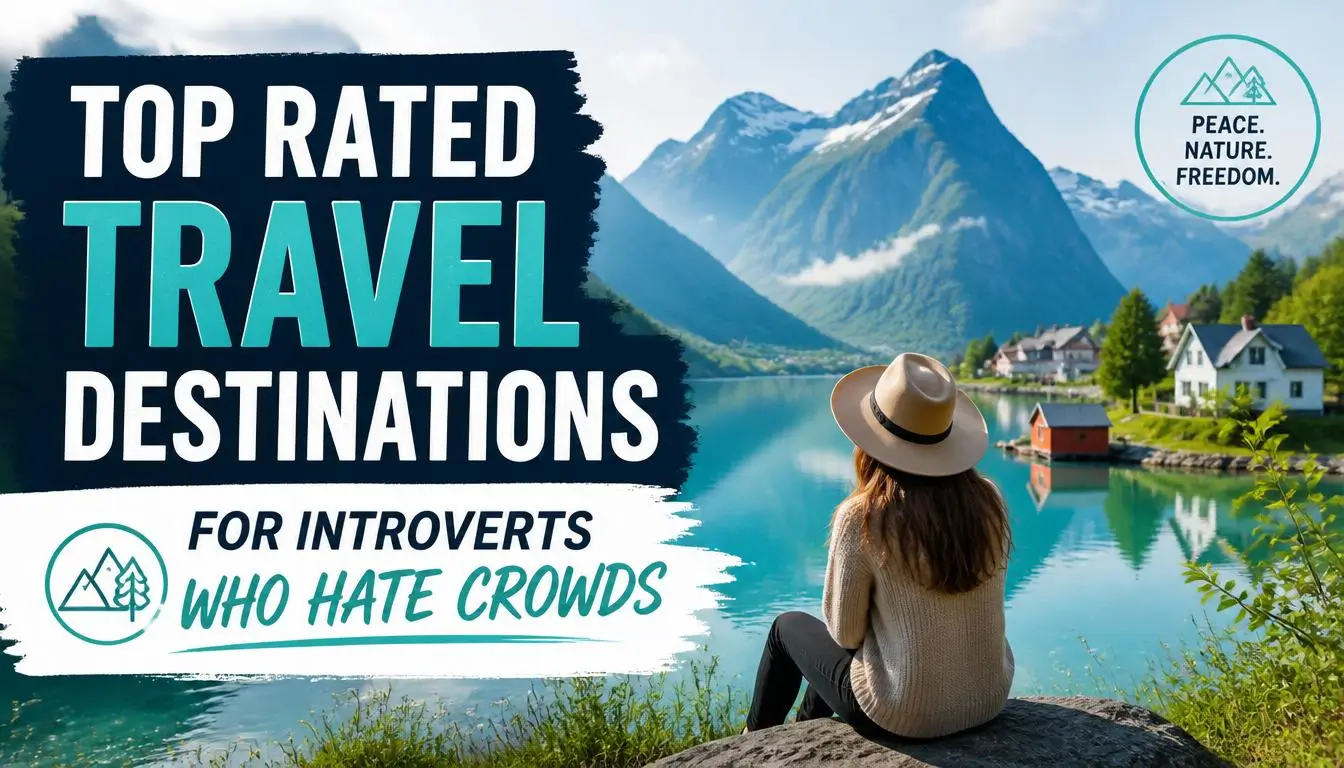
Top Rated Travel Destinations for Introverts Who Hate Crowds
The top rated travel destinations for introverts who avoid crowds are not the ones showing up on everyone’s Instagram feed this summer, and that is exactly the point. There is a specific kind of exhaustion that comes from standing in a heaving tourist line, surrounded by noise and elbows, wondering why you spent money to feel this overstimulated. Some of us travel to restore ourselves, not deplete ourselves further. These destinations actually do that.
1. Faroe Islands, Denmark
Arriving in the Faroe Islands feels like the world forgot to tell everyone else it exists. Eighteen volcanic islands sitting in the North Atlantic between Norway and Iceland, with dramatic cliffs, endless green hillsides, and a total population of about 54,000 people spread across all of them.

There are no massive resort strips here. No cruise ship crowds spilling into the streets. Just raw, cinematic landscapes that genuinely stop you mid-step. You can hike to sea cliffs where puffins nest inches from your boots and not see another person for hours. The village of Saksun, with its turf-roofed church and tidal lagoon, is the kind of place that makes introverts feel like they have finally found somewhere built for them. Infrastructure is good, locals are warm but not overbearing, and the quiet is so complete it takes a day or two to stop bracing for noise that never comes.
2. Kyoto, Japan (In the Right Neighborhoods)
Kyoto gets a bad reputation for crowds, and the reputation is earned in certain spots. Fushimi Inari at midday in July is genuinely overwhelming. But Kyoto is also a city of over 1,600 temples and shrines, and the vast majority of them see almost no visitors on any given day.
The Philosopher’s Path on an early weekday morning is one of the most peaceful walks in Asia. The northern Arashiyama neighborhood beyond the main bamboo grove becomes remarkably quiet within ten minutes of walking away from the main path. Temples like Jojakko-ji and Nison-in sit largely undiscovered by mass tourism despite being extraordinary. Kyoto rewards the traveler who wakes up early, moves slowly, and resists the pull of the obvious itinerary. For introverts who love history, architecture, and silence, it is one of the best cities on earth when you approach it on your own terms.
3. Slovenia
Slovenia might be the most underrated country in Europe, and part of what makes it so appealing for introverts is that it simply has not been overrun yet. Lake Bled gets visited, yes, but it is nothing like the shoulder-to-shoulder chaos of Santorini or the Amalfi Coast.
The capital Ljubljana is a walkable, human-scaled city where you can spend a full morning in a riverside cafe without feeling rushed or watched. The Soča Valley to the west has water so turquoise it looks digitally enhanced, surrounded by Julian Alps scenery that belongs in a film. Triglav National Park offers serious hiking with trail solitude that is genuinely hard to find in Western Europe anymore. The country is small enough to drive across in a few hours, which means you can keep moving without the logistical stress that drains introverts on complicated multi-country trips. Slovenia does not try to impress you. It just quietly is impressive.
4. Scottish Highlands, Scotland
There are parts of the Scottish Highlands where you can drive for an hour without passing another car. That is not an exaggeration. The northwest in particular, especially the North Coast 500 route beyond Ullapool, is the kind of empty that introverts daydream about from their open-plan offices.
Glencoe is dramatic and occasionally visited, but step off the main road and the crowds disappear instantly. The Outer Hebrides, a chain of islands off the northwest coast, have white sand beaches, ancient stone circles, and a pace of life so unhurried it almost feels disorienting after a week of normal modern life. Wild camping is legal in Scotland, which means you can pitch a tent on a loch shore with nothing around you but water and mountains and absolute silence. For introverts who recharge in nature rather than in people, very few places in Europe match what the Highlands deliver.
5. Bhutan
Bhutan controls its own tourism so deliberately that crowds are structurally impossible. The country charges a daily Sustainable Development Fee of $100 per person per day, which funds public services and intentionally keeps visitor numbers low. The result is a destination that feels completely untouched by mass tourism in a way almost nowhere else does.
The monasteries, rice terraces, and forested valleys feel genuinely ancient rather than preserved for tourist consumption. The Tiger’s Nest Monastery, clinging to a cliffside at 10,000 feet, is breathtaking and the hike to reach it is demanding enough to thin out even the modest crowds that do visit. Local culture is deeply intact here because the tourism model protects it rather than commodifying it. For introverts who travel to feel genuinely outside their own world, Bhutan offers that experience more completely than almost anywhere else on the planet. It is expensive by design, but what it delivers in solitude and authenticity justifies every dollar for the right traveler.
6. Azores, Portugal
Nine volcanic islands in the middle of the Atlantic Ocean, and most people still cannot point to them on a map. That is the Azores, and it is one of the best-kept travel secrets for introverts who genuinely need to feel away from everything.
São Miguel, the largest island, has crater lakes, hot springs you can soak in for free, and tea plantations that have been producing since the 1800s. Flores, further west, is so remote and so green it feels genuinely otherworldly. The islands are Portuguese territory, so infrastructure is solid and navigation is straightforward. Whale watching here is among the best in the world, done in small groups on quiet boats with naturalist guides who take it seriously. The Azores attract the kind of traveler who did their research, and that self-selection means even the people you do encounter tend to be quiet, curious, and respectful of the environment. IMO, it is the ideal introvert destination in the Atlantic.
7. Laos
Sitting between the more heavily visited Thailand and Vietnam, Laos gets skipped constantly, and that is precisely what makes it so special for introverts. It has none of the frenetic energy of Bangkok and none of the tourist infrastructure that can make Southeast Asia feel like a theme park.
Luang Prabang, a UNESCO World Heritage town on the Mekong River, operates on a pace so slow it rewires you within 48 hours. Monks walk the streets at dawn in silence for the alms-giving ceremony. Cafes open late. Nobody is rushing anywhere. The plain of Jars in the northeast, an ancient archaeological site with massive stone vessels scattered across rolling hills, sees almost no visitors and has an eerie, quiet beauty that feels like a genuine discovery. River journeys on the Mekong between towns are peaceful and long in the best way. Laos does not perform for tourists. It just exists, and for introverts, that is everything.
8. Patagonia, Argentina and Chile
Patagonia is big in the way that recalibrates your sense of scale. The landscapes here, jagged granite peaks, turquoise glacial lakes, windswept steppe stretching to every horizon, are so vast that even when other hikers are present, the space absorbs them completely.
Torres del Paine in Chile is the most visited part of Patagonia and still feels remarkably uncrowded compared to any equivalent destination in Europe or North America. Los Glaciares National Park in Argentina, home to the Perito Moreno Glacier, draws visitors but never feels overwhelming. The town of El Chaltén, known as Argentina’s trekking capital, has a population of under 2,000 people and a main street that closes down after 9 p.m. because everyone is tired from hiking. The wind alone will ensure you are not standing around making small talk with strangers. Patagonia selects for a specific type of traveler who wants challenge and solitude over comfort and convenience, and introverts tend to thrive in exactly that environment.
9. Alentejo, Portugal
While everyone else is fighting for space in Lisbon and the Algarve, the Alentejo region in southern Portugal sits largely undiscovered, offering cork forests, medieval hilltop villages, rolling golden plains, and some of the best wine in Europe.
Towns like Monsaraz and Marvão are perched on hilltops with panoramic views in every direction and populations small enough that you genuinely feel like you have found somewhere secret. The pace here is agricultural and unhurried. Lunches are long, afternoons are quiet, and evenings are spent watching the light change over the plains with a glass of local wine that costs almost nothing. There are no souvenir shops crowding every corner, no tour groups blocking the view, and no one trying to sell you a photo opportunity. For introverts who travel to think as much as to see, Alentejo offers the kind of quiet that actually lets that happen.
10. Iceland (Beyond the Golden Circle)
Iceland’s Golden Circle and Blue Lagoon are legitimately crowded now, and the reputation of Iceland as a solitude destination has taken a hit because of it. But Iceland is also enormous, and the moment you drive past the well-worn tourist routes, the isolation returns completely.
The Westfjords, a remote peninsula in the northwest, has roads that are partly gravel, infrastructure that is minimal, and landscapes so dramatic they feel almost confrontational. Hornstrandir Nature Reserve at the tip of the Westfjords is accessible only by boat and has no permanent residents, making it one of the most genuinely remote hiking destinations in Europe. The east coast of Iceland along the Ring Road sees a fraction of the visitors that cluster in the southwest. Hot pots in the highlands, accessible only by four-wheel drive, offer the experience of soaking in geothermally heated water with nobody else around for miles in any direction. That version of Iceland still very much exists. You just have to be willing to go a little further to find it.
Top Rated Travel Destinations for Introverts: How to Travel Better as One
Knowing the right destination is one thing. Knowing how to move through it in a way that actually restores you is another, and it is something most travel content skips entirely.
Book accommodation with private outdoor space whenever possible. A small terrace, a garden, or even a balcony gives you somewhere to decompress that is not a shared lobby or a crowded street. Travel during shoulder season, which is almost always less expensive anyway, and the crowd reduction is significant. Give yourself permission to skip the thing everyone says you have to see if it requires standing in a line for two hours surrounded by noise. The best introvert travel days are usually the unplanned ones, a long walk somewhere quiet, a local cafe where you sit for three hours reading, a viewpoint you found on a paper map rather than an algorithm. Those days do not make for dramatic travel content, but they are the ones you actually remember.
FAQs
What makes a destination genuinely good for introverts who avoid crowds?
The best destinations for introverts combine natural or cultural richness with low visitor density. Look for places without major cruise ship ports, with dispersed rather than concentrated attractions, and with a local culture that does not depend heavily on performative tourism. Shoulder season travel amplifies this in almost every destination on the list above.
Are top rated travel destinations for introverts also good for solo travelers?
Almost always yes. The qualities that make a place good for introverts, lower crowd density, slower pace, space for genuine solitude, also make solo travel easier and more enjoyable. Many of the destinations listed here, like Laos, Slovenia, and the Faroe Islands, have strong solo traveler communities and easy independent navigation.
Is it safe to travel alone to remote introvert-friendly destinations?
Generally yes, with sensible preparation. Remote destinations like Patagonia and the Westfjords of Iceland require more planning around safety, weather, and self-sufficiency than urban destinations. Always tell someone your itinerary, carry offline maps, and research local emergency contacts before heading into genuinely isolated areas.
How do I find the quiet parts of a popular destination?
Wake up earlier than almost everyone else, because the first two hours after sunrise are the quietest at most major sites. Walk ten to fifteen minutes in any direction away from the main attraction and crowds drop dramatically. Talk to locals rather than reading top-ten lists, because residents always know the spots that tourists walk straight past.
Can introverts enjoy group tours, or is independent travel always better?
Independent travel gives introverts far more control over pace and social exposure, which is usually preferable. That said, small group tours with eight or fewer people focused on hiking, photography, or wildlife can work well because the shared purpose reduces social pressure. Avoid large bus tours entirely if crowds and forced social interaction drain you.
Conclusion
The world has more quiet corners than the internet would have you believe, and most of them are more beautiful than the places everyone is already standing in line to see. Traveling as an introvert is not a limitation, it is honestly a filter that leads you somewhere better. Which destination on this list felt most like somewhere you could finally exhale?